
Search My Wealth Solutions

Free Consultation
Our Investment Philosophy

A flexible and intelligent investment approach tailored to your portfolio

Get a free consultation

The CAREphilosophy® is designed to work in the real world for people with a variety of portfolio goals and risk profiles.  While traditional investment theories are focused on asset selection, with a minor emphasis on market timing, the CARE Philosophy is designed to also absorb the risks posed by investor behaviour. 

The CAREphilosophy® is based on the principle that investor behaviour makes the difference in your investment success. Traditional investment theories are focused on where assets are allocated, with a minor emphasis on market timing and selection. The CAREphilosophy®, on the other hand, is made up of three key areas: investor behaviour makes up 50% of this; asset allocation 45%, and timing and selection 5%.

Currently, there is over $1,005 million invested utilising the CARE Investment Philosophy, with individual portfolios varying from $60,000 to $15 million.

45% of your returns come from your portfolio structure – not from timing the market or carefully hand-selecting your stock picks.  CARE puts this insight into practice, with a strategy that focuses on asset allocations that suit your goals and timeline, a bucket structure to ensure you are diversified and well-protected, and a Money on the Move function that allows you to make the most of market changes.  Around 50% of your returns are impacted by your behaviour. That’s why CARE aims to prevent bad investment decisions destroying the wealth you’ve worked hard to create.

The CAREphilosophy® Framework
About

About the CARE portfolio structure

CARE is split into four unique sections, or buckets, that work together. Each plays an important role in managing your wealth. Your asset allocation is tailored, based on your personal goals, your timeline to using your investment income, how you would like to use your money, and your risk tolerance.

The Core Investment bucket gives your investment portfolio a solid, diversified foundation. The rest of your wealth, depending on your portfolio size, will distribute across the Active, Reserves and Enhanced buckets. This distribution will be balanced as your needs change.

1. Core Investments

Core Investments

Your portfolio’s foundation, Core uses a low-cost, diversified strategy designed for the long haul.

The Core bucket is intended to be as diverse as possible so you can rest easy knowing it will hold through the normal ups and downs of the markets, as well as the extremes.

Core Investments includes multi-sector and multi-managed funds that form the base of your portfolio. This part of your portfolio includes a strategic mix of Australian shares and bonds, Exchange Traded Funds (ETFs), Index Funds, overseas shares and bonds, property and other income-producing assets.

2. Active Investments

Active Investments

Active Investments forms a part of our philosophy where we attempt to do the opposite of what most people do. When a market gets ahead of their long-term average, we remove you from that market and move your investment allocation to cash. When markets are under their long-term averages, we then take that cash and invest fully again.

The individual sectors where we move between cash and being fully invested include:

  • Australian shares
  • Global shares
  • Emerging markets
  • Small companies
  • Gold

This part of CARE is intended to smooth out the inherent volatility of each market sector in your portfolio and provide you with a steady, consistent return overall.

The tactical section of your portfolio: dynamically managed investments capture opportunities and enhance returns. Our team manages actively, smoothing volatility based on market trends.

3. Reserves and Risk Management

Reserves and Risk Management

The Reserves aspect of our philosophy means that we keep 4 years if you’re retired, or 2 if you’re not, worth of your spending needs in cash, term deposits and low volatility investments. This aspect of your portfolio is focused on reducing the likelihood of you having to sell your assets if the market experiences a decline.

This bucket is also being filled up each year by the income produced from other assets, so in reality you could have access for up to 7 years of income without ever having to sell your prized assets.

The Reserves and Risk Management bucket protection and stability during downturns. Cash liquidity and low-volatility investments prevent you having to sell valuable assets during crises or downturns.

4. Enhanced Returns

Enhanced Returns

A section focussed on opportunity, with tailored strategies to optimise performance. The goal is to deliver better-than-market returns, and provide
consistent income from blue-chip holdings.

As a whole, this part of your portfolio is intended to provide stability and pay out regular dividends.

The Enhanced Returns part of the CARE Philosophy is based on using a high focus direct share portfolio to provide you with a consistent income that has the tax already paid through franking credits on Australian shares.

The shares chosen for this aspect of your portfolio are generally blue chip. In other words, they have a consistent track record, good cash flow, low debt levels, good dividends and strong management and prospects.

About the CARE portfolio structure

CARE is split into four unique sections, or buckets, that work together. Each plays an important role in managing your wealth. Your asset allocation is tailored, based on your personal goals, your timeline to using your investment income, how you would like to use your money, and your risk tolerance.

The Core Investment bucket gives your investment portfolio a solid, diversified foundation. The rest of your wealth, depending on your portfolio size, will distribute across the Active, Reserves and Enhanced buckets. This distribution will be balanced as your needs change.

Core Investments

Your portfolio’s foundation, Core uses a low-cost, diversified strategy designed for the long haul.

The Core bucket is intended to be as diverse as possible so you can rest easy knowing it will hold through the normal ups and downs of the markets, as well as the extremes.

Core Investments includes multi-sector and multi-managed funds that form the base of your portfolio. This part of your portfolio includes a strategic mix of Australian shares and bonds, Exchange Traded Funds (ETFs), Index Funds, overseas shares and bonds, property and other income-producing assets.

Active Investments

Active Investments forms a part of our philosophy where we attempt to do the opposite of what most people do. When a market gets ahead of their long-term average, we remove you from that market and move your investment allocation to cash. When markets are under their long-term averages, we then take that cash and invest fully again.

The individual sectors where we move between cash and being fully invested include:

  • Australian shares
  • Global shares
  • Emerging markets
  • Small companies
  • Gold

This part of CARE is intended to smooth out the inherent volatility of each market sector in your portfolio and provide you with a steady, consistent return overall.

The tactical section of your portfolio: dynamically managed investments capture opportunities and enhance returns. Our team manages actively, smoothing volatility based on market trends.

Reserves and Risk Management

The Reserves aspect of our philosophy means that we keep 4 years if you’re retired, or 2 if you’re not, worth of your spending needs in cash, term deposits and low volatility investments. This aspect of your portfolio is focused on reducing the likelihood of you having to sell your assets if the market experiences a decline.

This bucket is also being filled up each year by the income produced from other assets, so in reality you could have access for up to 7 years of income without ever having to sell your prized assets.

The Reserves and Risk Management bucket protection and stability during downturns. Cash liquidity and low-volatility investments prevent you having to sell valuable assets during crises or downturns.

Enhanced Returns

A section focussed on opportunity, with tailored strategies to optimise performance. The goal is to deliver better-than-market returns, and provide
consistent income from blue-chip holdings.

As a whole, this part of your portfolio is intended to provide stability and pay out regular dividends.

The Enhanced Returns part of the CARE Philosophy is based on using a high focus direct share portfolio to provide you with a consistent income that has the tax already paid through franking credits on Australian shares.

The shares chosen for this aspect of your portfolio are generally blue chip. In other words, they have a consistent track record, good cash flow, low debt levels, good dividends and strong management and prospects.

Understand your entire portfolio

Why CARE?

CARE is designed from the ground-up to provide you with investment opportunities that will weather any fluctuation in the market.
DALBAR website

The Research Basis for CARE

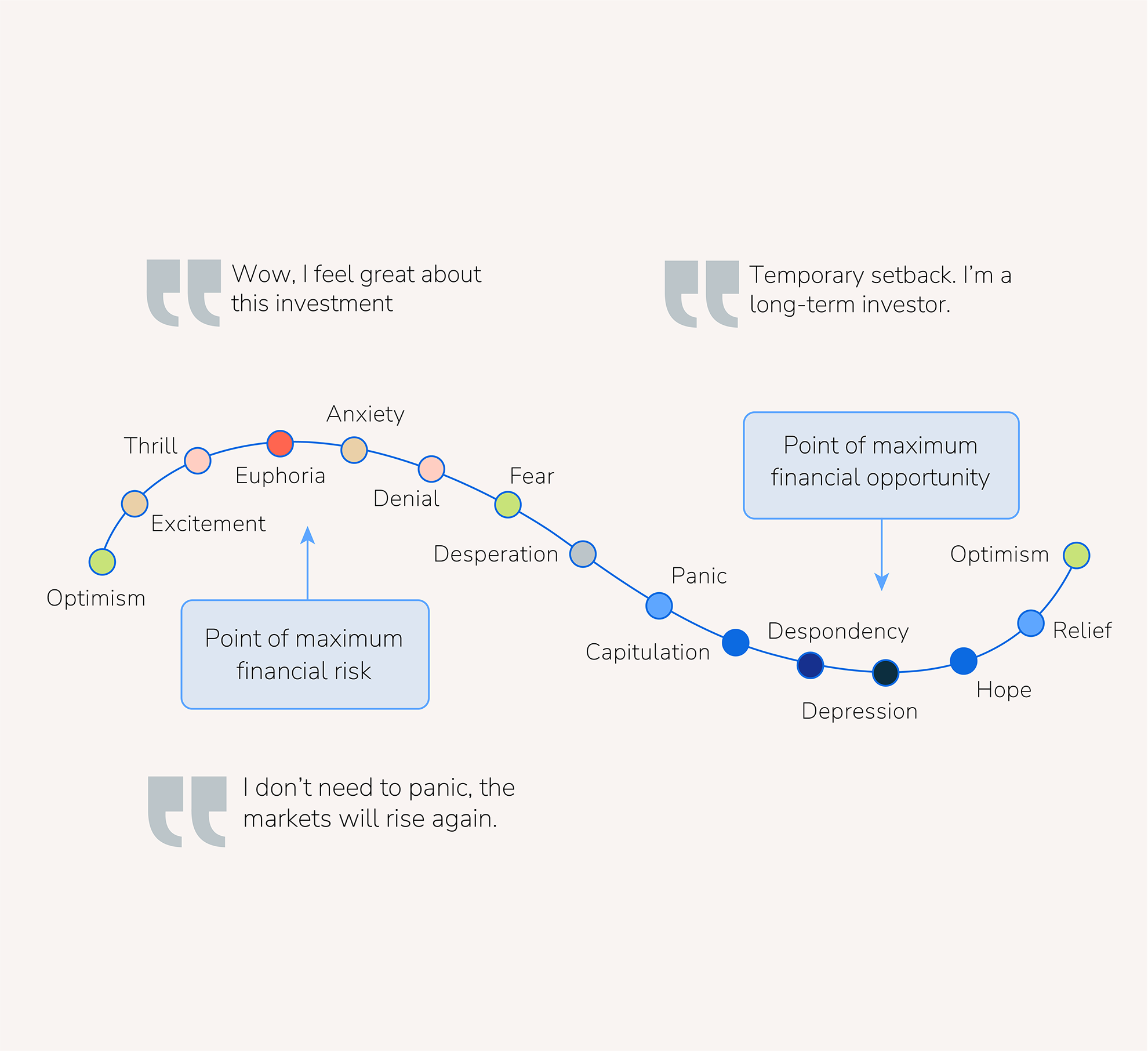
The DALBAR Study found that the average return from the top 500 U.S. listed companies between 1980 to 2000 in the U.S.A was 12%. In contrast, the average return for investors over the same period was 4%. What was the cause of that 8% difference? Negative investor behaviour.

The study found that the average holding period by investors – trying to invest for the long term – was just over 3 years. However, market decline caused these investors to panic and sell at the wrong time (based on world events that were out of their control). The result: consistently lower returns than investors who didn’t panic and held their investments for the long-term.

The real risk is not the market, or getting the timing right. It’s how you react. Booming markets make investors excited. They want to buy more, when it’s most expensive to buy. When markets fall, fear leads many to sell – at the worst possible time. This rollercoaster erodes wealth.

Read more about investor behaviour
Adult male at the office working on his laptop

The benefits of our process

  • Designed to weather any market fluctuations
  • Aimed at growing your wealth for the long-term
  • Consistent, easy and straightforward communication
  • Helping you to gain an uncomplicated understanding of WHY you hold every investment in your portfolio
  • Ensuring your portfolio delivers long-term returns in order to reach and maintain your goals
  • Utilising our Money on the Move technique, allowing you to avoid common investing mistakes during periods of volatility while taking advantage of lower prices during market lows
  • Adjusting your strategy as your investment portfolio grows or your needs change

We help you to grow and adapt your investment strategy as your wealth grows or the market changes to ensure you are always on track to achieving your financial goals.

We offer specialised investment strategies for ethical investors, business owners, or investing beginners, that address their individual needs in ways that are not normally provided for within traditional investment strategies.

We don’t rely on speculation or market timing; strategies that often prove ineffective. Instead, we focus on building a smart, forward-looking investment plan that’s designed to weather market ups and downs and support your financial success for years to come.

male professional in a meeting smiling

Expert support at every step

By investing with CARE, you’ll by supported through:

  • Quarterly economic updates with Emmanuel Calligeris
  • Investing With CARE webinars
  • CARE members with over $1 million invested will receive a personal invitation to CARE half-yearly updates with the committee.

These benefits are all available in addition to the support offered by your team of financial experts at My Wealth Solutions.

As part of our ongoing commitment to helping you create your dream financial future, our team:

  • Is here to assist you at all times in making smart financial decisions
  • Will be continually monitoring, adapting, evolving, and adjusting to any legislative or market changes as well as any changes to your circumstance
  • Can connect you to our extensive network of professionals that share the same core values and dedication to your financial success
  • Will continue to adjust and realign your strategy in our review meetings with you as you reach financial milestones throughout your journey

Our 20 Investment Beliefs

Clear, defined financial goals should form the basis of any investment decision. Whether you’re saving for a house, building a nest-egg for retirement or just want to maximise your retirement income, defining exactly why you want to invest will help us to choose the right investment options for you.

In our experience, neither speculating – otherwise known as the process of buying an asset in the hope that the price will go up and you will make a profit – nor saving are investment strategies.

Investing is buying an asset while planning to enjoy the income generated from that asset. If the investment is a good one, made after thoroughly researching how it meets your unique financial goals, then the income and asset value will grow. You can then reinvest this income to grow your wealth.

For most of us, our investment time frame should be the rest of our life. But in a practical sense, we define long-term investing generally as 5 to 7 years. By simply buying assets, which are known as passive assets, you will be able to build your wealth without being actively involved.

Active investments, which include renovating a property or buying a business, have the ability to produce much higher returns than passive assets but they also come with a much higher chance of losing all your money.

Both shares and property produce an income, shares through dividends and property through rent. Both also form important cornerstones of your overall investment strategy. Shares and property generally grow in value if they are well selected and can be held directly or through managed investments.

As professional financial advisors, we have more time, resources, education and experience in selecting and managing your investment portfolio. Creating and growing a healthy investment portfolio can be a complicated task, with questions like what to buy, when to buy, how to value and when to sell is only the beginning.

Having a team of expert financial advisors on your side means that every investment decision you make will be based on comprehensive research and tailored to your unique needs.

But shares also have one downside: they frequently fluctuate in value. This is perfectly normal and something to be expected as a shareholder. When held for the long-term and appropriately diversified, shares consistently deliver a strong return when compared to other types of passive investments.

Although many try, it’s impossible to predict the short-term movements of the share market. That’s why we focus on long-term buy and hold for our core investments, which deliver good returns to investors and make the timing of markets unnecessary.
This philosophy also works for those with large amounts of cash to be invested, who may find it easier to place those investments over a period of time rather than in one lump sum. This means you’ll be able to avoid the pitfalls of investing at a market high in favour of receiving a steady average return over a period of time.

A bubble describes when the markets, in a speculative frenzy, push up prices to unsustainable levels. They can be hard to spot but can be identified by two key factors.

  • The first sign is that prices have risen rapidly over a short period, with returns becoming an unsustainable 30% to 50% per annum.
  • The second is that the income generated from these inflated investments will be extremely low or non-existent when expressed as a percentage by historical standards.

There may be times when certain aspects of your portfolio have delivered above average returns or have achieved long-term targets in a shorter timeframe.

During these times, it may be advisable to sell some assets and hold cash to invest in future opportunities, or to switch to a sector that has been underperforming.

Property tends to go through cycles where values will approximately double in a short time then stagnate. These cycles are unpredictable but have previously lasted anywhere from 7 to 20 years.

Long-term investors know that while one value double is rewarding, the real aim is to hold for 3 or 4 doubles for greater returns.

Although property will generally grow slightly less than shares, banks will continue to lend up to 90% to you so that you can build wealth more rapidly while using leverage to buy property. But this strategy also comes with increased risk.

In retirement, when you will have hopefully paid off your debts, property tends to generate less income and have more costs to maintain it than other investments. Because of this, a retirement strategy based on residential property alone will require significantly more assets than if diversified across other assets.

If you ask anyone who has owned a property for 20 or 30 years, they will generally say that it was an expensive purchase at the time but now seems cheap by comparison. For example, the median price of a residential property in Brisbane in 1985 was $61,550 according to the ABS.

In theory, diversification means not putting all of your eggs in one basket. In practice, it involves holding a wide variety of investments across different sectors and within those sectors across different asset types, countries and investment managers.
Diversification helps you reach the returns you need to achieve your long-term goals with the least amount of risk possible. This enables you to avoid stress and lowers the risk of making bad decisions when markets inevitably fluctuate.

It might sound like stating the obvious but it is incredibly difficult to recover from losing 50% to 100% of your investment.

That’s why it’s best to avoid big mistakes like:

  • Chasing high returns, such as during a bubble
  • Not getting expert advice before investing
  • Choosing investments claiming to offer guaranteed returns that are significantly higher than bank accounts or bonds
  • Investing in products you don’t understand
  • Excessive trading of investments looking for short-term gain
  • Saving but using investments that can and might fluctuate in value to do so
  • Selling viable investments due to short-term issues or focus

This means something different for wealth builders and retirees.

For wealth builders it means:

  • Having sufficient insurances to protect yourself
  • Making sure you have access to spare cash and/or credit
  • Investing in share markets using dollar cost averaging to ensure you have a steady return
  • Leveraging into residential property

While for retirees, it means:

  • Having sufficient cash reserves to support yourself in the case of market fluctuations
  • Keeping at least four years’ worth of known expenditure in short-term or lower-risk investments, so that good quality growth investments never have to be sold to meet short-term needs.

Planning helps you understand your current position and define your goals. It also helps you to decide where you want to be and which steps you need to take to get there. Overall, it provides a clear focus for the many financial decisions that will need to be made.

Strategy is all about investing intelligently to meet your specific financial goals. Strategy can help with everything from deciding who should own an investment to more complex issues like gearing or using superannuation effectively. Together, planning and strategy can help you grow your wealth and meet your short, medium and long-term goals.

Many people choose not to invest because they think they don’t have enough money. In fact, the opposite is true as the only way to achieve wealth (aside from winning or inheriting it) is to invest. It is never too late to start investing and no amount is too small. Long-term investing of small amounts, combined with solid compound returns, is the right way to grow your wealth.

This is one of our fundamental beliefs and serves as a philosophy that underpins how we advise our clients.

For those that are looking for exciting money, speculative advice or short-term market timing, we cannot provide adequate investment advice as it contradicts this fundamental investment belief. However, we may be able to advise on planning or strategy.

There are many factors to consider when you’re looking at buying a residential investment property. To make sure that you’re choosing the right investment for your unique financial circumstances, here are a few things to consider:

  • It is better to choose an investment property in an area with a dense population to ensure a greater chance of rental income and tenant occupancy. An Australian capital city that has not recently had a property boom is a great place to start looking.
  • When it comes to maximising capital growth, the closer to an Australian capital city CBD you can buy, the better. Within 5 to 10 kilometres of a CBD is ideal, while you should avoid property further than 100 kilometres from a CBD.
  • Avoid property in small, remote and rural mining towns. When the mining project ends, fly-in fly-out workers often fly out permanently.
  • You should plan on holding your property for the long-term, or at least 10+ years. Investing for income and capital growth is a much better strategy than investing for tax benefits or for the short or medium terms.
  • A new property will have less maintenance costs, can attract higher rental yields and will enable higher depreciation and building amortisation deductions. An older property may be purchased at a lower cost and may be better value for money, but those approaching retirement will need to be aware of higher maintenance costs.
  • Whenever you can: favour houses over units and units over studios as the land size is generally larger when it comes to capital growth and rental incomes are usually higher.
  • Choose property that is close to the CBD, shopping centres, schools, public transport, restaurants, parks and gyms.

When it comes to the details of actually buying an investment property, you have 4 broad options to consider:

  • Do it yourself: some people enjoy searching for and buying properties themselves. Others, however, find the process overwhelming or simply don’t have the time.
  • Use local real estate agents: much like buying a home, you can use local real estate agents to help you in finding an investment property.You can provide them with a list of your requirements, such as budget, rent yield, etc. and then pick from the properties they show you.
  • Use a buyer’s agent: your team of financial advisors can work directly with a buyer’s agent to help you find your ideal property. A buyer’s agent is a licensed real estate professional who legally acts on the behalf of the purchaser.We provide your requirements to them and they search for a property that ticks all of your boxes.
  • Use a property research company: we can also assist you by introducing you to a property research company. These companies are licensed real estate agents who are authorised to sell properties to you. The properties they have available are usually new properties sourced directly from developers.Property research companies have unique research processes that enable them to identify properties that best meet their investment criteria and your requirements. They can also provide an expert opinion on the best locations to buy properties.

Get expert insights direct to your inbox, spam free.