

Watching your little one grow and dream is pure magic, right? But those tiny humans can come with a hefty price tag, and it’s not just the nappies and cute outfits.
Planning for your child’s education can feel overwhelming. For many parents, it’s not just about school fees; it’s about giving them the best possible start in a world that’s changing rapidly.
Private education costs in Australia are climbing faster than a toddler on a mission (just like lots of living expenses), and it’s enough to make any parent’s heart skip a beat – and not in a good way! But there is a way to achieve the education you desire for your children; it just takes a good financial plan.
We work with a lot of clients to find a way for them to make their dreams for their kid’s education a reality, without sacrificing their other lifestyle goals. In this article, we’ll be looking at the true cost of education and how to evaluate your choices. We’ll also share strategies to prepare financially to give your kids a private education.
I’m based in Brisbane, and where you went to school has historically carried some weight here. Many private schools are known for specific strengths—St Joseph’s Nudgee College excels in sports, while St Peter’s Lutheran College is known for its music chops.
Securing a spot at your preferred school requires early planning, especially for private primary schools, which can be highly competitive. In fact, some families apply as soon as their child is born!
While some parents prefer their child to stay at one school from primary through Year 12, others opt for a mixed approach: public education for primary and private school for high school. This strategy can be more affordable since public schools offer free tuition, with only voluntary contributions for resources and facilities—much lower than private school fees.
Using this time to save for future private school tuition can ease financial pressure later on. However, transitioning to private high school still requires planning, as spots in sought-after schools often need to be secured years in advance.
Getting that education plan in place is a real benefit when it comes to the financial planning side of things. We help a lot of clients, whatever their timeline, make sure they can afford the fees through savings, investments or other strategies.
Educational expenses have been on the rise, sometimes faster than inflation. So what are we looking at exactly, and how do your different options compare?
There are three main options: Public school, Religious private schools, or Independent private schools. The table below looks at their tuition costs per year, based on the Futurity Group’s Cost of Education 2025 and the Feesable School Fees in Australia 2025 Report.
The range of costs within the private school category are pretty significant. For example, the most expensive in the country is Geelong Grammar School, which costs around $50,000 without including ancillary costs. In contrast, the most expensive private school in Brisbane is Brisbane Grammar, at $32,180 per year. However, the annual median is much lower: In QLD, the median is $10,160, in NSW it’s $11,194, and in VIC it’s $12,046.
Keep in mind that these medians include regional areas – for example, the median for regional QLD is $7,100, while the median for Brisbane City is $15,560.
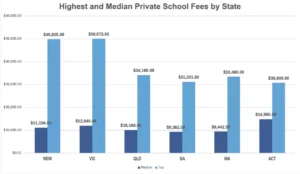
Data from Edstart School Fees Report 2024
There are also a lot of ancillary costs to consider. These can include:
These ancillary costs are real – but many of them are also optional. As reported by the Guardian, ancillary costs make up 96% of costs for public schools, 77% for religious schools, and 45% of costs for independent schools
Some states have subsidies for ancillary costs like transportation. For example, in New South Wales, school students are entitled to free public transport if they live further than walking distance from their school, and are entitled to subsidised public transport even if they live within a specified minimum distance.
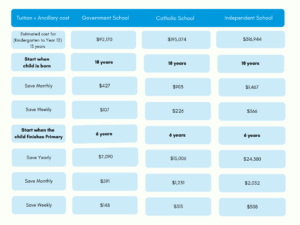
We did a simple cost illustration for you below, taking the average national tuition fees plus ancillary costs, so you could see how much money you should be saving periodically for future education expenses. We’ve look at the weekly and annual savings, considering the type of school: both private school from kindergarten onwards, or just for secondary school.
So what are the best ways to save for education?
Cashflow management can be another way of increasing your ability to send your kids to the private school of your choice. We work with clients, particularly those who are well into their parenthood journey and haven’t yet found a solution for the financial challenge of tuition fees.
Using cashflow strategies is usually part of a holistic approach to your financial world. To illustrate how this can work on an individual level, I’ve included a case study of my clients, Rakesh and Maryam (not their real names).
Sometimes, seeing how others navigate this journey can be really useful. Take Rakesh and Maryam, for example. They had two, seemingly contradictory, financial goals: early retirement and a top-notch private education for their two children.
We worked together to create a two-phase strategy:
The outcome: Our strategies resulted in doubling cashflow within a year, as well as achieving long-term wealth building of an additional $2.65M at retirement. With this strategic plan including restructuring, investment, and tax optimisation, they were able to achieve both their goals: an early retirement (in just 12 years), and their choice of a preferred school for their children. Their story is a testament to the power of strategic planning and a little professional advice.
If the financial burden feels heavy, there are options you could look into such as:
Education is an investment in your child’s future – their dreams, their passions, their potential. It’s about giving them the tools to thrive in a world that’s constantly evolving. And while the financial side is important, don’t forget the emotional connection too. Talk to your children about their aspirations, involve them in the planning process and show them the value of saving for their future.
However, ultimately the main influence of success for your child is how much time you spend with them, how much love you invest in them, and how much of your own knowledge and experience you share with them. Research shows that having a strong family life is one of the biggest influences on future success – it creates confidence and stability that serves your children well for the rest of their lives.
So whether you choose a government school, Catholic school or public school, consider the impact of funding the additional costs of an expensive education. For example, if you have to work long hours to afford the education you want for your child, it might mean they miss out on valuable time with you.
With strategic forward planning and smart saving, I know you’ll create a bright future for your little ones. And if you’re interested in getting some help, get in touch to speak to a financial adviser – it can really help to make an informed decision and understand the financial implications for your family.