



Imagine waking up in the morning feeling completely free of financial anxiety.
Your bills were automatically being paid, your debts were managed and steadily shrinking, your money was invested in all the right places, and your savings account kept growing. Even better, your family was protected.
This is a glimpse of financial freedom. Because financial freedom is more than just having lots of money. At the heart of monetary freedom is clarity, fulfilment, and liberation from worry.
Getting to this point takes planning, commitment and perseverance. It also requires knowing where to start. In this guide, I’ll walk you through the process of creating your own financial plan. I recommend starting at the top and working through each section, and as you go you’ll start to develop a comprehensive plan for mastering your money.
Simply put, a financial plan summarises your financial goals, identifies your current situation, and outlines a process to manage your money to move you towards your goals. Your plan should be written down and then actioned over time. This means it should be a guiding document for your financial life that covers your savings and debts, your cash flow, your investment strategy or property goals, your retirement plan and superannuation, and your future planning such as insurance and estate planning.
Want to avoid that feeling of knowing you should do something, but not knowing what to do next? A financial plan ultimately will provide clarity about where you are now and what your next step should be.
Aim to create a plan that:
These benefits can be genuinely life-changing when applied to your personal financial plan.
This guide provides a framework for creating a simple and effective financial plan yourself. For the average person, financial planning hinges on wise handling of simple financial systems such as saving, managing debt, and tracking where your money goes. If you have the time and discipline to manage your finances, you can certainly do so in many situations.
However, it is wise to enlist a financial planner once your money is a little more complex, when you reach certain key moments in your life, or if you have certain goals that you need support to achieve. To pull together a holistic financial strategy is difficult if you’re not skilled in understanding finances or spotting financial opportunities. It can also take considerable time and energy to manage it, hold yourself accountable, and keep it up to date.
Another thing you might want to consider is your ability to separate emotions from your financial decision making. One of the key benefits of a financial advisor is objectivity – they can assess financial decisions without emotions or history clouding their analysis.
First, take an honest look at your current financial situation to identify the gaps between where you are now and where you want to be.
We use a series of questions that you can use to evaluate your personal situation. The higher the difference between your current score (1) and your desired score (5), the bigger the gap in your financial journey (this also shows the areas that need the most attention in your planning).
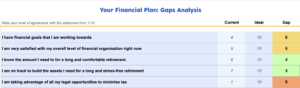
Gaps Analysis Worksheet
Identify the gaps in your financial preparation and your areas of future focus with this worksheet.
If you feel daunted by your gaps analysis, we offer a free consultation with our financial advisors, to review your personal situation and think about what is possible for you.
To fully understand your financial situation, start writing down all your assets and liabilities. We recommend taking the time to detail your debts, along with their interest rates and payment plan. Use this information to calculate your net worth.
Example: [Assets (home, car, superannuation, investments, cash savings)] – [Liabilities (debts, loans, credit cards, student loans)] = your net worth
Next is your monthly cash flow and your budget. Before creating your new budget, review your expenses for the previous year and document your spending for necessities, bills and repayments, and other categories. Create your cash flow statement by subtracting all these expenses from what your earnings were for the same period.
Example: $5,000 (monthly income) – $2,800 (monthly expenses) = $2,200 (surplus)
Understanding your surplus is one of the most important parts of this exercise. If you have a surplus, also known as positive cash flow, this will help you reach your goals more quickly. If you’re in the red or just breaking even, use your budget to begin to cut unnecessary spending. If budgeting is new to you, you can get started with our simple budget builder or Plan Your Life budget builder!
Read more about budgeting here >
Make sure your cash flow projection is accurate by knowing exactly how much of each pay check is committed to budget items. Break down monthly, annual or variable expenses into weekly to make sure nothing is missed.
Setting realistic goals is an important step to stop the slide of time from catching you out. Outline your life goals as best you can in the present moment, looking at short-term goals (1 year), mid-term (1-5 years), and long-term goals (5-15 years). Your finances are deeply connected to your life, so start by thinking about the life you want to build.
Everyone has different life goals. Maybe yours is to retire early, to leave a legacy for your loved ones or to generate passive income by 45. To find your most essential money goals, ask yourself:
The best way to build success into your goals is by ensuring they are specific and achievable. For example, you could use the SMART methodology (example only):
Read more about setting financial goals here >
Whether you’re just starting out or have been saving diligently for years, saving money is a dynamic process that requires strategic planning.
Saving is a journey, not a destination. It’s all about consistency. As you’re in control of where your money goes, you’ll see it bringing you closer to your goals.
Learn more about saving and budgeting techniques >
Although it might seem secure, storing cash in your savings account often earns less than the rate of inflation, meaning that your money is actually losing value.
For wealth creation, investing is the single biggest factor. The difference between those with wealth and those without comes down to who has built and held assets or investments, whether property or shares.
It’s ok to start small. You can open a brokerage account yourself with a bit of research. Contributing a set amount at regular intervals (let’s say every pay check) into this ongoing investment portfolio is a simple and effective tactic known as Dollar Cost Averaging. Doing this means you don’t have to track what’s up and what’s down – it balances itself over time, particularly if you’re investing in bundled options such as ETFs or mutual funds.
Remember, all stock, real estate, or other investments have risks, as well as strategies to manage those risks. If you’re unsure, it’s helpful to get investment advice.
Take these factors into account:
Learn more about investing in property vs shares >
The fifth component to creating a robust financial plan is to understand and optimise your superannuation fund. Superannuation plays a pivotal role in securing your financial future, so don’t underestimate the importance of making sure it is performing well.
Super funds can differ in the returns they deliver, their service fees, and as a consequence, your ultimate retirement fund balance. Make sure you know what to look for in your superfund.
It can be valuable to estimate how much superannuation you might enter retirement with using the MoneySmart Superannuation Calculator.
Lean more about superannuation >
Not all debt is bad and it can be hugely beneficial to grow wealth. However, debt is often mismanaged or ignored, and it can turn into a monster.
Debt management can be used in one or two ways:
If you have a credit card debt or a car loan, review your interest rates and balances. Prioritise paying debt with the highest interest first, as it is costing you the most. Check out the debt avalanche or debt snowball methods for some ideas.
Using debt to grow wealth can be a complex strategy, so we recommend consulting with a financial planner. Additionally, if you feel the amount of debt in front of you is insurmountable, it can be helpful to speak to a financial counsellor.
Learn more about how to pay off debts >
Whether your tax is simple or complicated, tax season should never surprise you. Getting a good accountant will obviously make your life a lot easier in this regard, but an effective tax strategy is about preparation.
Tax planning simply involves making decisions and setting up your finances throughout the year to maximise your tax position. Of course, tax planning is always within the law; we are not talking about tax avoidance.
This could be everything from recording your tax-deductible expenses, to purchasing business equipment at the right time, to making tax-effective investments, or understanding your deductions or depreciation on investment property.
Tax planning and research allows you to understand the implications of tax ahead of time, and act accordingly.
Learn more about tax planning >
No matter your stage of life, ask yourself, ‘how much do I need to retire to live the lifestyle I want to have?’ This is a great first step in incorporating your retirement planning into your finances from now on.
If you are approaching retirement age, consider your current retirement savings. Know exactly how much you have, and Review AFSA’s retirement standard to calculate how long your funds will last and your lifestyle level. Use your budget to know your current living expenses and assume around 80% of that amount for retirement living.
If you’re younger, and haven’t thought about retirement yet, it might simply involve ensuring that your super is optimised. However, if you’re looking forward to an early retirement or something like lots of travel, it’s wise to work towards that now.
Debts such as a mortgage, or unplanned expenses such as medical bills, can eat into your retirement funds. Many of our clients want to pay off their mortgage before reaching retirement. You might need to build this goal into your retirement plan, or aim to have additional funds saved to continue paying your debts.
If you need help, a retirement advisor can help you get a clear picture of what your retirement will look like, and help create the life you want to live post-work.
Learn more about creating a personalised retirement plan >
You want your financial plan to include protection for you and your family in case of financial setbacks. For example, if you have an accident and can’t work for two years, this part of your plan jumps into action, in tandem with your emergency fund cash reserve.
Briefly there are several main types of personal protection that we look at with our clients.
Income Protection
Income protection insurance is designed to replace your income for a specified period of time, in the event that you cannot work due to an injury or disability. This is valuable if you are self-employed, have dependents, or have debt that will need to be covered.
Total & Permanent Disability (TPD) Insurance
Where Income protection provides regular payments, TPD insurance is a lump-sum payout if you become permanently disabled. This permanent disability could be defined as within your own occupation, or more commonly, in any occupation.
Trauma Insurance
Trauma insurance is, like TPD, a lump sum payment. However, Trauma insurance is also called ‘recovery insurance’ or ‘critical illness’, because it is useful to help pay medical costs or cover living expenses while you are recovering.
Life Insurance
Life insurance isn’t to protect you, but your family in the event of your death. If you are the primary breadwinner, losing you is not only a heart-breaking personal loss, but potentially a devastating financial blow. Life insurance provides those you leave behind with financial security.
How much cover do you need? Be aware not to over-insure or have excessive cover that may not provide additional value.
Another important component, and one that our financial advisers build into each plan we complete, is how your plan will improve your wealth over time. Adding opportunities into your financial situation can make a powerful difference to your finances over your lifetime.
These opportunities might be challenging to research and activate. Many complex financial structuring or planning requires the assistance of finance professionals.
Wealth-building opportunities might include:
Read our Top 10 ways to increase your wealth >
By now, we’ve worked through the essential steps of creating a personal financial plan. You have a holistic view of your situation, while working towards your time-based priorities.
Implementing your plan might look like:
Discipline is the key to success after creating your financial plan; concrete and actionable steps will help you stay on track and achieve your goals. I recommend writing down the actions you need to take and ticking them off once they are accomplished.
After setting up your financial plan and seeing it in motion, it’s crucial to regularly assess and adjust it according to any changes in your life or goals.
Monthly, set a regular time to review:
Annually, a more thorough review should look at:
Think about any changes in risk tolerance, marriage, or having children that may be coming up, which may change your goals or priorities.
Don’t put off reviewing your finances, because it really is like a checkup for your financial health. A regular financial review will strengthen your confidence and continue to grow your financial acumen.
– – – – – –
If building your own financial plan feels like a huge undertaking, or you don’t have time to devote to it, that’s ok. Many Australians struggle to find the time to research and implement big financial changes in their lives.
In our financial advice firm, your advisor does the hard work of creating and implementing a completely personalised strategy, and keeping you accountable with regular reviews. Not sure if you’re ready to go the professional route? Learn how much money you need to have to make a financial planner worthwhile.
If you’re interested in our financial planning services, book a free consultation.

Co-founder and Director of My Wealth Solutions, Guy has around 20 years of experience in holistic financial planning and wealth management.
B. Biomedical Science, Dip. FP, Adv. Dip. FP, SMSF
View my profile